Site Contents


 /
/ 


|
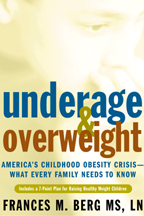
Underage & Overweight
America's childhood obesity crisis — What every family needs to know
UNDERAGE AND OVERWEIGHT: America's Childhood Obesity Crisis – What Every Family Needs to Know by Frances M. Berg Hatherleigh Press ISBN 1-57826-120-1 $24.95 hardcover, 456 pages |
The
statistics are alarming: Over the past three decades obesity has tripled
for children and teenagers, increasing to the point where 15 percent
are overweight and another 15 percent are at risk. Youth obesity, now
skyrocketing out of control, is associated with increases in high cholesterol,
high blood pressure, and type 2 diabetes; and obese youth are more
likely to become obese adults.
How did we get to this point? What does it mean for parents? And
most important, where do we go from here?
The answers are in this new book: Underage and Overweight:
America’s Childhood Obesity Crisis--What Every Family Needs to Know.
In it, author Frances M. Berg, long-time editor of Healthy Weight Journal,
offers clear, insightful, and research-backed advice for parents and
caregivers. This comprehensive book offers a new philosophy of health
at any size for parents, teachers, policy makers.
"It’s time to take a new approach to wellness and wholeness," says
Berg. "Time to focus on promoting healthy, confident, diet-free lifestyles
for our children, on preventing weight and eating problems, instead
of causing them," she says.
Studies and statistics prove that diets and food restriction don’t
work; instead, they can lead to eating disorders, malnutrition, and
increased weight gain in the long run. Hard-hitting but compassionate,
this important book lays bare the weaknesses of current health care
for large children. Parents may be appalled to find how weak is the
science on which much of obesity treatment is based.
Chaotic eating has become the norm for children and teens of all
sizes as they diet, fast, binge, skip meals, undereat and overeat.
Their efforts to lose weight can be extremely dangerous and result
in lasting injury and even death. One-fourth of all teenage girls
are severely undernourished, and many girls as well as increasing
numbers of boys suffer eating disorders. Underage and Overweight identifies
the cultural, social, physiological, emotional and spiritual issues
facing kids today and how these issues collide.
To normalize eating, parents are advised to end their own dieting
and help children rediscover their internal cues of hunger and satiety.
A 7-step plan for raising healthy-weight children, ideal for parents
and caregivers, is included. By changing the way our families think
about food and physical activity, we encourage children and teens to
learn healthy habits that should dramatically reduce the rates of
overweight and obesity in American youth.
Underage and Overweight encourages families to promote
a healthier lifestyle in which all children receive consistent messages
to eat well, live actively, and feel good about themselves and others.
It clears up the confusion parents often feel, offers sound and simple
guidelines, and makes mealtimes easier and more pleasant for everyone.
It stresses the importance of communication, sharing feelings, and
mutual support within the family.
Underage and Overweight is invaluable in bringing together
weight and eating research, and making it easily accessible to those
who work with children. The book contains many charts, graphs, lists,
short items, and an appendix providing a wealth of resources, all essential
to professionals. Whether used by a health care provider, workshop
leader, counselor, educator, coach, parent, author, or marketer, these references
will be valuable time after time.
A helpful and insightful guide to healthy living for the whole family,
Underage and Overweight provides solutions for parents who
are concerned about overweight or obesity in their children--or who
simply want to learn how to help their children lead healthier, more
active lives.
| About the Author: Frances M Berg, MS, LN, a licensed nutritionist and family wellness specialist, author of 11 books, and an Adjunct Professor at the University of North Dakota School of Medicine, has spent over two decades researching and writing about weight and eating. Now, she brings her lifetime of knowledge to bear on the problems of obesity in children and teens in Underage and Overweight. Her earlier books include Children and Teens Afraid to Eat and Women Afraid to Eat. |
How to order:
| Preface |
||
| PART I: Battle
for our children's health |
||
| 1. |
America’s Childhood Obesity Crisis |
|
| 2. |
The Dangers of Obesity |
|
| PART I I: Root
Causes |
||
| 3. |
Childhood Obesity: Nature versus Nurture |
|
| 4. |
The Consequences of Sedentary Living |
|
| 5. |
Dysfunctional Eating: An Overview |
|
| 6. |
The Death of Family Meal Time |
|
| 7. |
Feeding Our Kids at School: Who’s in Charge? |
|
| PART I I I: False
Starts |
||
| 8. |
Why Past Solutions Haven’t Worked |
|
| 9. |
Dieting is Not the Answer |
|
| 10. |
Challenges for Overweight Children |
|
| PART I V: A New
Perspective |
||
| 11. |
Wellness & Wholeness |
|
| 12. |
Health at Any Size |
|
| PART V: Effecting
Change |
||
| 13. |
What Works; What Doesn’t |
|
| 14. |
Benefits of Active Living |
|
| 15. |
Normalizing Your Child’s Eating |
|
| 16. |
The Basics of Good Nutrition |
|
| 17. |
What Schools Can Do |
|
| 18. |
Shaping a Nurturing Environment |
|
| 19. |
Healthcare: A New Paradigm |
|
| 20. |
Seven Steps to a Healthier Weight |
|
| 21. |
Helping the Overweight Child |
|
| Resources |
||
| Index |
||
America’s Childhood Obesity Crisis
One can hardly pick up a newspaper or turn on the television without
hearing the disturbing news that overweight is on the rise--for children
as well as adults. It's front page news, the topic of television documentaries
and talk show interviews with alarmed heart specialists.
And it’s true. The prevalence of overweight has
increased sharply since the early 1980s. Solid evidence for the increase
comes from the National Health and Nutrition Examination Studies (NHANES),
the nation’s most comprehensive look at our health and nutrition. In
this series of multiyear studies, beginning in the mid 1960s, large,
representative samples of Americans were interviewed, weighed, measured,
and clinically tested in mobile clinical centers. Our newest statistics,
based on the 1999-2000 NHANES, provide the following findings for childhood
overweight (that is, children whose weight falls at or above the 95th
percentile):
* 15 percent of children age six to 19 are overweight.
* 10 percent of children age two to five are overweight.
What alarms public health officials is that overweight
rates for children have been steadily increasing since the 1960s and
1970s, when they had remained fairly stable, at about 5 to 6 percent.
. . .
Though statistics on the prevalence of
overweight in children are staggering, it is important to consider
them in their proper context--not all kids are gaining weight. However,
there are more overweight children now than there were in the past.
A few decades ago there was perhaps one large
child in a class of twenty students--now there are two or three. In areas
with low income or high minority populations as many as half of the
students may be overweight.
Nonetheless, if you go to a school and look around
you’ll see that most children and teenagers are quite slender. They
are representative of that other 85 percent of children, whose body
types range from tall and rail thin to short with soft curves, and
everything in between. In this 85 percent you will see the signs of
children moving through natural stages of puberty, rapid growth, and
emerging maturity. It is important to remember that the weights of
children, other than the 15 percent who are overweight, have remained
steady over the past three decades.
Yet if we use current adult rates of overweight
to project the future for our typical class of twenty, six students
will become obese and six will become overweight as they reach adulthood.
And as percentages of childhood overweight continue to rise, so do
risks for a new generation of adults susceptible to weight-related
health conditions.
A similar pattern of increasing weight for children
can be seen worldwide. . . .
So why did it happen? Why this big increase in
weight from 5 percent of children in the 1960s to 15 percent in 2003? Is
it our sedentary lifestyle? Do kids just eat too much or eat too much
of the wrong foods? Has restrictive dieting backfired? Is overweight
related to genetic vulnerability? Infection? Or is due to our biggest
population increases occurring in the very groups most vulnerable to
obesity?
Fifteen years ago obesity researchers examined
their data on child and adult weight gains, and shook their heads,
"We haven’t seen anything yet," they said, "just wait until these kids
grow up."
The time to wait and see is over. The time to
act is now. . . .
Wellness and Wholeness
It’s time to take a new approach to wellness and wholeness. Time
to focus on promoting healthy, happy lifestyles for our children,
on preventing weight and eating problems, instead of causing them.
This is an urgent challenge for America and countries around the world.
The traditional ways of dealing with weight through food restriction
and the dieting mentality have not worked, and are causing grave harm.
The new approach asks: How can we help the child
shift to healthier habits that last a lifetime? How can we prevent
weight and eating problems? How can we help each child be healthier
at the size he or she is now?
A healthy body is only part of good health. The
World Health Organization defines health as a state of complete physical,
mental, and social well-being and not merely the absence of disease
or infirmity. Wellness involves guiding the child toward making healthy
choices in all these areas.
By choosing a wellness lifestyle, we can prevent
much disease and disability, and can cope better with inescapable
experiences of illness, disability or trauma. The wellness approach to
life combines sound physical, mental and emotional health in a positive
relationship with family and community.
Wellness is free, or costs very little, and is
enjoyable from the first moment. It improves the quality of life, the
richness of life, the simple joy of living well. The journey of wellness
begins in infancy. It’s a journey that parents can enjoy in the moment
and look forward to with pleasure. The wellness approach takes a positive
view, avoiding a focus on the negative:
* Wellness is not about perfection
* Wellness is not about numbers
* Wellness is not about fearing disease
* Wellness is not about criticism, blame, or shame.
It’s helpful to think of wellness as a wheel,
to visualize how the six dimensions of wellness complement and interact
with each other. When one aspect is strong, it strengthens and positively
affects the others. Yet all are needed, and a balance of growth in
each dimension helps the wheel roll along smoothly. . . .
Many things of importance are going on in your child’s life. Weight is only one part and must not be allowed to distort the many other aspects of your child’s health and well being. Think about the big picture. Think about wellness. Help your child grow and blossom in all six dimensions of wellness--physical, intellectual, emotional, social, occupational, and spiritual. . . .
Health at Any Size
In the Health at Any Size approach, also known as Health at Every
Size, people are free to take pleasure in food again. They rediscover
normalized eating--tuning in to hunger and satiety cues, eating to
meet energy and nutrient needs, and trusting their bodies to make up
for times of eating too much or too little. They rediscover the joys of
living actively, happily discarding the miserly goals of exercise for
calorie burn.
For people schooled in weight-centered, control
thinking, Health at Any Size is a 180-degree shift that profoundly
changes not just their thinking, but their knowledge and behavior as
well. They become advocates for a lifestyle free of dieting.
Health at Any Size affirms the truth that beauty, health
and strength come in all sizes. That health is not defined by body
weight, but by physical, mental and social well-being. The Health at Any
Size approach asks: How can this child be healthier at the weight he
or she is now? How can we help this child gradually shift to healthier
habits that improve health and weight, and last a lifetime? How can
we prevent weight and eating problems for this child and every
child?
Health at Any Size rejects the false notion that
thin children are healthy and large children unhealthy. Rather, it
accepts the truth that large children and thin children are a normal part
of the human spectrum, and all deserve respect and consideration. It
celebrates diversity as a positive characteristic of the human race.
It reassures parents that, of course, children can be healthy at their
natural size and weight. That children are healthiest at the weight
that develops from a healthy lifestyle. Restrictive thinking is left
behind.
Health at Any Size helps people recognize that
we don’t know how to make large kids thin, but we do know what doesn’t
work. It helps health professionals recognize that much harm has been
done in attempts to help large kids lose weight, and that failed experimental
methods perpetrated on children need to stop. . . .
Seven Steps to Healthier Weight
Healthy Weight Kids is a seven-step program for helping children
and teens develop and adopt a healthy, confident, diet-free lifestyle
in which sound habits come so naturally, they need not think about
them. It works for youth of all sizes and ages. With this plan young
people on the wrong track can change direction, rediscover active living
and normalized eating, and build a strong foundation for a positive
health journey through life. As a parent, you can help free them to
live in normal, healthy ways, restore life’s balance in body, mind
and spirit and move on to what’s really important in their lives.
The focus is on four major areas of life: living
actively, eating well, feeling good about ourselves, and feeling good
about others. The goal is for lasting change that makes a real difference,
not quick results.
So relax and enjoy the journey with your child.
| 456 pages | |||
| 6 x 9 | Healthy Weight Network | ||
| 402 South 14th Street
Hettinger, ND 58639 |
|||
| $24.95, hardcover | 701-567-2646; fax 701-567-2602 | ||
| [email protected] | |||

|
|||
To read excerpts from the 21 chapters, click here
For reviews and commentary, click here
For information on FREE Raising Healthy Weight Children magnet, click here
|
New Book Listing
Information |
|
Title: |
underage & overweight America's childhood obesity crisis — What every family needs to know |
Author: |
Frances M. Berg, MS, LN |
Publisher: |
Hatherleigh Press Long Island City, NY |
ISBN/Cost: |
Hardcover 1-57826-120-1 $24.95 |
Size/Pages: |
6 x 9, 456 pages |
Publication Date: |
January 2004 |
Bibliography/Index: |
Included |
Illustrations: |
Charts, graphs |
Target Audience: |
Parents, teachers, health professionals |
Distributed by: |
Available at bookstores
everywhere and online from Amazon.com and Barnes & Noble.
Distributed by W.W. Norton, 500 5th Ave., New York, NY 10110.
(Orders 1-800-233-4830; Customer service 1-800-233-4830; Fax orders
1-800-458-6515).
|
Description: |
|
|
A helpful and
insightful guide to healthy living, Underage and Overweight
provides solutions for parents who are concerned about overweight
or obesity in their children – or who simply want to learn how
to help their children lead healthier, more active lives. Basically, the book accomplishes two major goals:
1) it’s a guide to healthy living for the whole family, including
a 7-step plan for raising healthy weight kids; and 2) it brings
together the research on related topics and provides this research in a
way that is easy to understand and explain.
|
|